A missing site board is easy to spot. A badly planned one usually is not - until deliveries go to the wrong gate, pedestrians ignore hazards, or key contact details are nowhere to be found when something goes wrong. That is why construction site signage requirements matter. They are not just about ticking a compliance box. They affect safety, site access, public communication and how professionally a project is managed from day one.
For contractors, developers and site managers, the real challenge is not whether signs are needed. It is knowing which signs are essential, where they should go, what they need to say, and how durable they need to be for the life of the job. Some sites need a simple, clear setup. Others need layered signage for multiple trades, vehicle routes, public interfaces and changing risks.
What construction site signage requirements usually cover
In practical terms, construction site signage requirements in the UK tend to fall into two categories. The first is statutory and safety-led signage, which supports legal duties around health and safety. The second is operational signage, which keeps the site running properly by directing people, identifying responsibilities and reducing avoidable confusion.
Safety signage is shaped by the nature of the risks on site. If there are moving vehicles, excavations, overhead work, restricted zones or mandatory PPE rules, those hazards need to be communicated clearly. This is where warning signs, prohibition signs, mandatory instruction signs and emergency information become essential rather than optional.
Operational signage is broader. This can include site entrance boards, developer or principal contractor identification, directional signs, delivery instructions, welfare location signs, visitor reporting points and hoarding boards. These may not all be legal requirements in every case, but on active sites they are often necessary for control, efficiency and public-facing communication.
The signs most sites need from the start
Every site is different, but there are a few sign types that appear on most UK construction projects. Entrance signage is usually the first priority. It should make clear who is running the site, how to make contact, and what rules apply before anyone enters. If the site has public exposure, this sign also helps reassure neighbours, local authorities and visitors that the project is being managed properly.
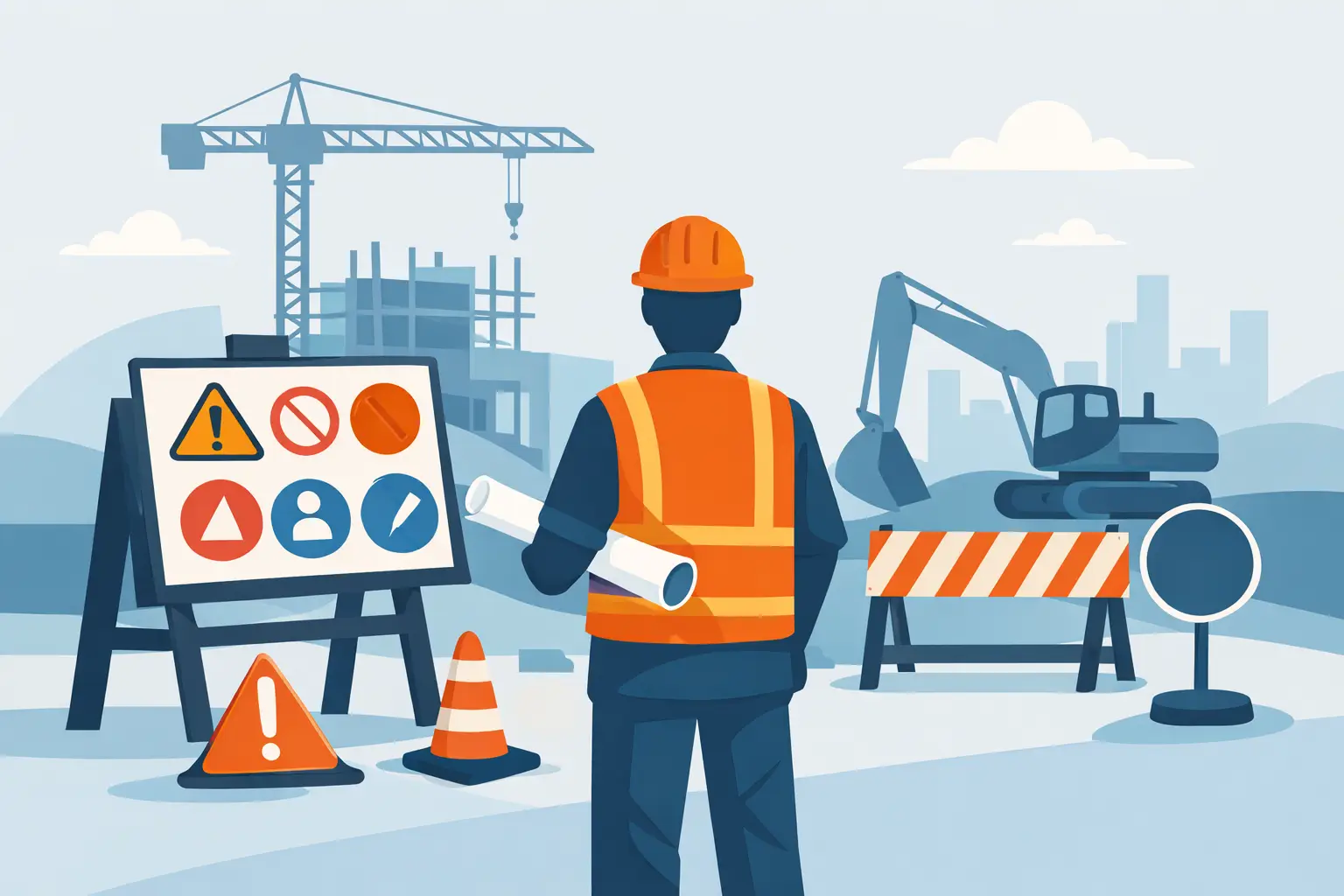
Health and safety signs are the next layer. These commonly include PPE requirements such as hard hats, high-visibility clothing, safety footwear and eye protection. They may also include no unauthorised access, warning notices for plant movement, deep excavations, overhead loads or hazardous substances, and emergency assembly point signage.
Fire and first aid information also needs proper visibility. On a small, straightforward site, that may mean a limited number of clearly positioned boards. On a larger site with multiple compounds and access routes, one sign at the gate is rarely enough. Information needs to be placed where decisions are made, not only where people first arrive.
Why compliance is only part of the job
A common mistake is treating signage as a one-off procurement task. Order a few standard boards, cable-tie them to fencing, and move on. That approach may cover the basics, but it often falls short once the site starts changing.
Construction sites are not static environments. Access points shift, compounds move, delivery routes change and hazards evolve as the build progresses. A sign that made sense in week one may be misleading by week six. This is where good site managers take a practical view. Signage needs to be reviewed as part of normal site control, not left to age in place while the job moves around it.
There is also the issue of legibility. A compliant message is not much use if it is too small, hidden behind stacked materials or faded by weather. Construction site signage requirements are met properly when the information is clear, visible and relevant at the point of use.
Placement matters as much as content
The best sign in the wrong place is still a poor sign. Positioning should reflect how people actually move through and around the site. Pedestrian routes, vehicle entrances, welfare units, loading areas and restricted zones all need signage that is visible before a decision is made, not after.
At the perimeter, signs should be easy to read from a reasonable approach distance. At internal access points, they need to face the flow of movement. If a delivery driver only sees the instructions after turning into the wrong entrance, the sign has not done its job.
Height, angle and background all affect visibility. On busy fencing lines or hoarding runs, signs can get lost among other graphics, notices and temporary postings. Keeping core safety and operational messages distinct helps avoid visual clutter. In some cases, fewer boards with clearer hierarchy work better than a crowded wall of mixed information.
Materials and print choices for site conditions
Not every site sign needs to be built the same way. A short-term housing development launch board has different demands from an operational health and safety board fixed to temporary fencing for several months. The right material depends on location, expected lifespan and exposure.
For many construction applications, correx is a practical choice because it is lightweight, cost-effective and well suited to temporary or medium-term use. It is easy to fix to fencing, hoarding and site barriers, and it works well for repeated operational orders where speed and budget both matter. For buyers managing multiple plots, compounds or live developments, that matters.
That said, there are trade-offs. On highly exposed sites, or where signs will be handled repeatedly, a heavier-duty substrate may sometimes be the better option. The right answer depends on weather exposure, fixing method, replacement cycle and how often the information is likely to change. A site board that needs updating every few weeks should not be over-specified. A sign intended to stay sharp at the public frontage for the duration of a long build needs more thought.
Getting the wording right
Good site signage is plain, direct and hard to misread. That sounds obvious, but many boards become overloaded with text, logos and secondary information that weakens the main message. On a live site, people need to understand instructions quickly.
Short wording usually performs best. Mandatory actions should be explicit. Warnings should state the hazard clearly. Contact information should be current and easy to find. If the board includes branding, it should support the message rather than compete with it.
This is especially important for principal contractor boards and public-facing signage. These often serve more than one purpose at once - site identification, contact details, safety instruction and brand presentation. Trying to force all of that into a badly balanced layout usually leads to weak communication. Clear hierarchy is what makes a board work.
Common gaps buyers overlook
One of the biggest gaps is under-ordering. Buyers sometimes budget for the front gate and public hoarding, but not for internal navigation, welfare points or secondary access. That can leave sites patchy, especially once subcontractors, visitors and deliveries increase.
Another issue is buying generic signs without considering site-specific risks. Standard PPE and warning boards are useful, but they may not cover temporary traffic management, changing plot access, or restricted areas linked to the programme. If the site has unusual risks or a complex layout, the signage plan needs to reflect that.
There is also the practical matter of replacement. Temporary signs get damaged, removed or weathered. Ordering with a sensible spare allowance can save time later, particularly on larger schemes or repeated rollouts. For commercial buyers, this is often where a specialist supplier adds value - not with overcomplication, but with quick repeat fulfilment and consistent output.
A sensible buying approach for construction signage
For most trade buyers, the best approach is to split signage into fixed and variable needs. Fixed signs are the core boards likely to appear on every project - site entrance, PPE, unauthorised access, hazard warnings and emergency information. Variable signs are the ones tied to the layout, programme or client requirements of a specific site.
That makes procurement simpler. Standard signs can be reordered quickly and in volume, while project-specific boards can be produced to suit each location. It also helps with cost control. There is no need to reinvent routine signage every time a new job starts.
If you are managing multiple sites, consistency matters as well. A standard format across projects makes signs easier to recognise, easier to replace and easier to deploy. It also gives clients and site teams a more professional impression. Businesses such as Trade Boards are often used this way by repeat buyers who need fast turnaround without making every order a custom production exercise.
Construction signage does not need to be overthought, but it does need to be planned. When the boards are clear, durable and positioned properly, they help the site work better from the outside fence to the furthest compound. That is usually the difference between signage that is merely present and signage that is actually useful.